Cancer treatments for many patients, including those diagnosed with melanoma, have been revolutionised with the introduction of immunotherapy to the clinic. One class of these biologic drugs are called immune checkpoint inhibitors e.g. pembrolizumab and these have transformed outcomes for many patients, even those with metastatic disease. However, there are only a small number of immune checkpoint drugs in use currently. Approximately half of patients now survive a diagnosis of metastatic melanoma with combination immunotherapy. Prior to this nearly all patients with this diagnosis and stage of disease did not survive.
There are a lot of other potential immune checkpoint drugs that are likely to work in the same way but at the moment, it is not possible to anticipate which patients will responds to what drugs, prior to treatment. The goals of this work were to (i) assess how current immune checkpoints are benefiting immune responses in patients (ii) investigate what type and how many different immune checkpoints melanoma patients express on immune cells with a view to personalising treatments for patients. We found that patients vary a lot in terms of which and how many immune checkpoint targets they have. This means that some patients are receiving therapies that are not going to work effectively but they may benefit from another drug that is currently in the clinical trial pipeline. We can predict in the lab what patients should be treated by what drug for optimal outcome.
The potential exists to streamline and personalise immune checkpoints for patients so that patients are screened in advance and get the immunotherapy that is most likely to work for them. Our work thus far has focussed on patients diagnosed with melanoma but this approach is also relevant to other cancer types.
The funding arising from the John Barragry Award and The Meath Foundation allowed for a collaboration between Tallaght University Oncologist Fergal Kelleher and Prof. Clair Gardiner an Immunologist in Trinity College Dublin. This facilitated a Master of Science degree for Jack Behan a student within TCD. Eimear Myelod, a post-doctoral researcher, within the auspices of the Dept. of Biochemistry and Immunology also contributed substantially to the research effort. The research greatly benefited from the altruism of patients in the Trinity Affiliated Hospital consenting to provide blood to allow this research.
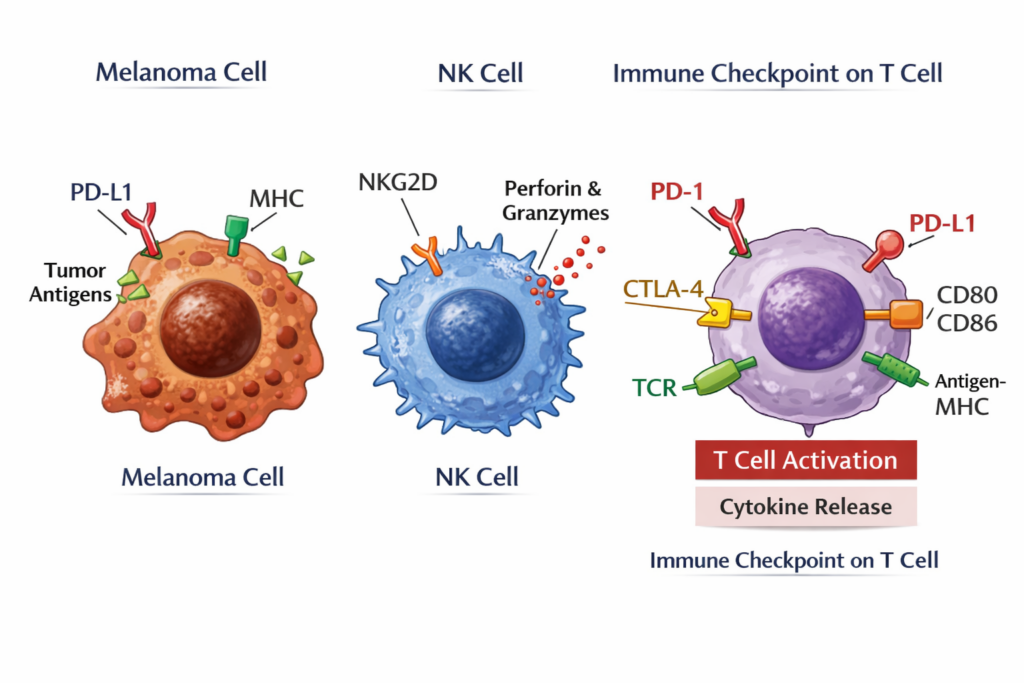
Diagram: Some of the cells that were the subject of the project
Fergal Kelleher graduated in Medicine from University College Cork in 1997. Subsequent to internship he obtained a Master of Science Degree from University College Dublin arising from research on genomic imprinting in bladder cancer. He worked in the areas of Surgery and Internal Medicine in Dublin’s major academic teaching hospitals obtaining the postgraduate qualifications of Associate Fellowship Royal College of Surgeons of Ireland (AFRCSI) and Fellowship of the Royal Colleges of Physicians Ireland and London (FRCPI, FRCP(London)). He subsequently trained in Medical Oncology in Dublin and later completed a Fellowship in Medical Oncology in Peter MacCallum Cancer Centre, Melbourne, Australia. This was in the areas on Melanoma, Sarcoma, and Gastrointestinal malignancies. During this time, he worked for Prof. Grant McArthur (Order of Australia) a leading international expert on melanoma. He has a Medical Doctorate (MD) by published work from University College Cork and is a Clinical Associate Professor in Medicine, Trinity College Dublin. Fergal has lead author publications in numerous international cancer journals including Clinical Cancer Research (AACR), Annals of Internal Medicine, Cancer Letters, and the European Journal of Cancer. He has worked as a Consultant Medical Oncologist in Tallaght University Hospital since 2016.
Clair Gardiner is a Prof. in Immunology in Trinity College Dublin. She graduated from Dublin City University and undertook a Ph.D. in paediatric Immunology (CHI, UCD). After a post-doctoral fellowship in Stanford University, she returned to Ireland where she established her lab in Trinity College in 2002, to work on NK cell research. She has supervised numerous students and published over 60 peer-reviewed publications. Her work focusses on understanding how NK cells work and how they can be optimally used for immunotherapy.

Fergal Kelleher
Clair Gardiner
Links to publications arising from the John Barragry award.
Mitochondrial impairment and mTORC1 signalling exhaustion define NK Cell dysfunction progression in melanoma.
Cancer Immunology Immunotherapy
https://pubmed.ncbi.nlm.nih.gov/41843165
A further publication is currently in the peer review process.